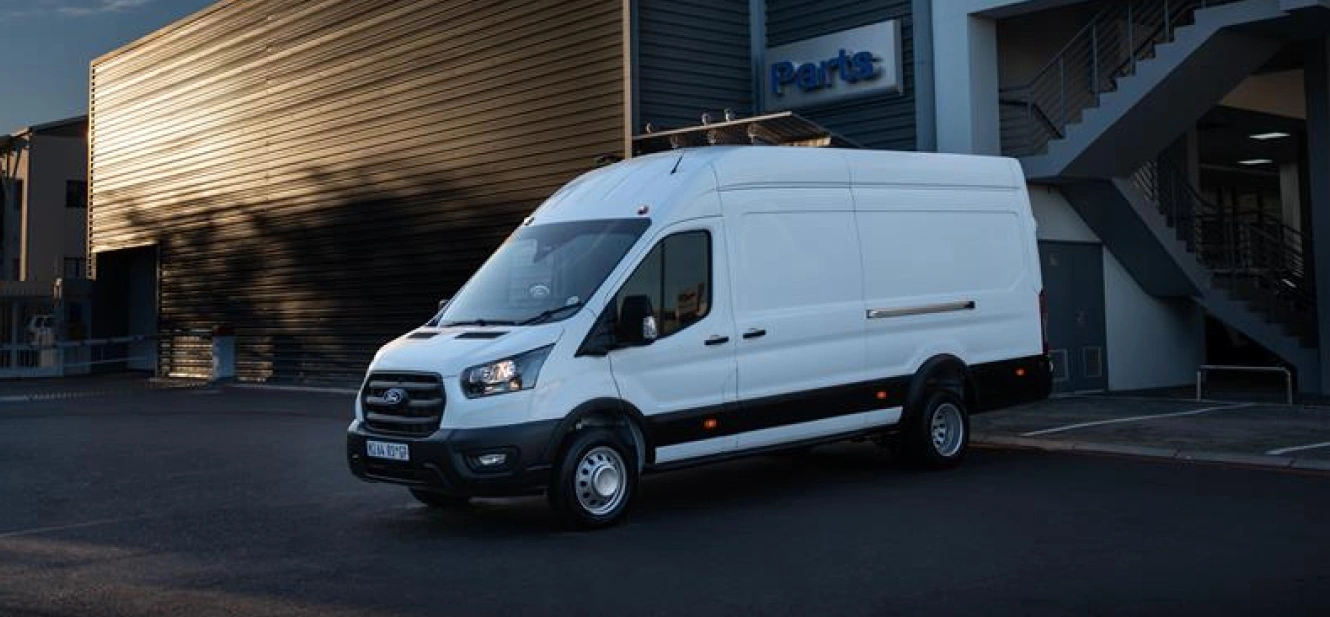
PRETORIA, SOUTH AFRICA, 30 January 2026 - The attraction of Ford Motor Company of Southern Africa (Manufacturing) (Pty) Limited (“Ford South Africa”) Transit Van range has been given a boost with the addition of a new versatile and practical derivative that features a longer body and bigger load carrying ability.
The Extra Long Wheelbase (ELBW) Transit joins its siblings as the fourth-generation Ford Transit Van alongside the Transit Custom Base, Transit Custom Sport, and Transit Van.
The Transit boasts an impressive history that harks back to the introduction of the first-generation Ford Transit Mark 1 with its iconic design in the United Kingdom in 1965.
“Over the past six decades, the iconic Ford Transit has proven itself in many applications - from commercial to leisure activities. The Transit Van has evolved over the years and with the development of the modern extra-long body we have been able to widen the options for our customers, which include small and medium enterprises, freight haulers and courier companies,” says Sunil Sewmohan, Product Marketing Director at Ford South Africa.
“The new ELWB Transit, with its great appetite for hard work, combines a competitive carrying capacity with dependable power, exceptional fuel economy and low CO2 emissions from Ford’s advanced Duratorq TDCi diesel engine” says Sewmohan.
The size and the extensive list of standard convenience and luxury features of the Transit also lends it to several conversion options, using the Ford ProConverter programme which has identified and accredited more than a dozen third-party modifiers who adhere to Ford’s strict quality standards.
Among the favourite conversions are emergency vehicles, refrigeration vans and people transporters (buses and taxis).
Practicality and payload
The main difference between the new ELWB Transit and its slightly smaller LWB range partner, which was launched in 2025, lies with its exterior and interior dimensions, as well as gross vehicle mass, kerb weight, gross payload and load capacities.
Although the two Transit derivatives share the same wheelbase of 3 750 mm, the new ELWB version has longer (6 785 mm) body dimensions than the LWB (5 981 mm). The body width of both versions without mirrors is 2 059 mm, and the maximum loadspace width 1 784 mm.
Both versions also have the same kerbside sliding door width (1 300 mm), while the rear cargo doors opening height is higher (1 987 mm) compared to the LWB derivative (1 748 mm). The kerbside sliding door and rear cargo doors that open up to 180-degrees offer effortless access to load cargo in the Transit Vans.
The Transit offers impressive load carrying capability with up to 15,1 cubic metres of load volume (vs. 13 cubic metres in the LWB); 2 270kg gross payload capacity (1 325kg for the LWB); and a load length of more than 4m in the Transit (3m in the LWB version).
The new ELWB Transit features dual 16-inch 195/75 rear steel wheels on each side, whereas the LWB version comes with single 16-inch 235/65 steel wheels all round.
A maximum braked towing mass of 3 500kg is specified for the new ELWB Transit (2 800kg for the LWB) with an unbraked maximum towing of 750kg for both derivatives.
Further standard enhancements of the load compartment include a complete rear trim board, a moulded load floor liner, 12 load floor tie-down hooks for securing cargo, and load space lighting. Extra heavy-duty batteries for longer load bay lighting when the vehicle is stationary can be added as additional equipment.
Drivetrain
Delivering 121kW maximum power and 390Nm maximum torque, Ford’s advanced 2.0-litre Duratorq turbodiesel engine propels the ELWB Transit efficiently and economically through 6-speed manual transmission.
Power is transmitted to the rear wheels, and one of three available drive modes - Normal, Eco, and Slippery - can be selected for more efficient and economical driving. Fuel consumption is 9,3 litres/100 km on a combined test cycle.
The 4-cylinder Duratorq TDCi engine’s exhaust phase incorporates the use of AdBlue, an additive that converts harmful nitrogen oxide exhaust emissions into harmless nitrogen and water, reducing environmental impact. The AdBlue liquid, made up of special chemicals such as Urea and water, is stored in a separate 20-litre tank in the Transit.
The AdBlue feature is part of Ford’s ECOnetic Technology that brings together a series of innovations that minimise fuel consumption, carbon emissions, and running costs.
Technologies and comfort features
Ford’s SYNC4 infotainment system combines a 12-inch touchscreen with easy smartphone integration, including Apple CarPlay and Android Auto connectivity, conversational voice recognition, cloud-based connectivity, and much more.
The Ford app is linked to the 5G embedded modem in the vehicle, offering features including Remote Lock/Unlock, Vehicle Locator, Vehicle Health Alerts, Vehicle Status, Intelligent Oil Life Monitor and Enhanced Customer Connectivity Settings.
Cup holders and a driver’s arm rest bring comfort to the cabin, along with steering wheel mounted remote audio controls.
Safety
Equipped with a host of safety features, the Ford Transit offers a high level of protection for both driver and passengers, as well as other road users.
Among the standard advanced safety systems are a driver airbag; 3-point safety belts for driver and passenger; an Electronic Stability Programme (ESP) with Traction Control; Hill Launch Assist; Rollover Mitigation; ABS brakes with Electronic Brakeforce Distribution and Emergency Brake Assist. A Tyre Pressure Monitoring System is also a standard feature.
The Transit is sold standard with the additional Driver Assistance Package, which includes Collision Mitigation; Adaptive Speed Control; a Blind Spot Information System; Lane Changing Warning & Aid, Reverse and Front Parking Aid; Reverse Brake Assist; and a 360-degree Front/Side/Rear View Camera as a parking aid.
Additional safety and security features include a standard alarm system and factory-fitted immobiliser, remote-operated central door locks with two-stage unlocking, and drive-away locking with a crash unlocking function.
Recommended Retail (includes VAT):
- Ford Transit ELWB R1 062 000.00
The recommended retail price includes a 6-year/90 000 km Ford Optional Service Plan, 4-year/120 000 km Ford warranty, 4-year/unlimited distance Roadside Assistance and 5-year/unlimited distance corrosion warranty. In addition, a 2-year/unlimited distance over-the-counter (OTC) parts and service parts warranty (SPW) is also included in the price. The recommended service interval is 15 000 km or annually, whichever occurs first.
Customers can purchase Ford Protect Service or Maintenance Plan upgrades up to 8 years or 165 000 km. The warranty can be extended up to 7 years or 200 000 km, while the Roadside Assistance can be extended for an additional one or two years. T&Cs apply
PRETORIA, SOUTH AFRICA, 30 January 2026 - The attraction of Ford Motor Company of Southern Africa (Manufacturing) (Pty) Limited (“Ford South Africa”) Transit Van range has been given a boost with the addition of a new versatile and practical derivative that features a longer body and bigger load carrying ability.
The Extra Long Wheelbase (ELBW) Transit joins its siblings as the fourth-generation Ford Transit Van alongside the Transit Custom Base, Transit Custom Sport, and Transit Van.
The Transit boasts an impressive history that harks back to the introduction of the first-generation Ford Transit Mark 1 with its iconic design in the United Kingdom in 1965.
“Over the past six decades, the iconic Ford Transit has proven itself in many applications - from commercial to leisure activities. The Transit Van has evolved over the years and with the development of the modern extra-long body we have been able to widen the options for our customers, which include small and medium enterprises, freight haulers and courier companies,” says Sunil Sewmohan, Product Marketing Director at Ford South Africa.
“The new ELWB Transit, with its great appetite for hard work, combines a competitive carrying capacity with dependable power, exceptional fuel economy and low CO2 emissions from Ford’s advanced Duratorq TDCi diesel engine” says Sewmohan.
The size and the extensive list of standard convenience and luxury features of the Transit also lends it to several conversion options, using the Ford ProConverter programme which has identified and accredited more than a dozen third-party modifiers who adhere to Ford’s strict quality standards.
Among the favourite conversions are emergency vehicles, refrigeration vans and people transporters (buses and taxis).
Practicality and payload
The main difference between the new ELWB Transit and its slightly smaller LWB range partner, which was launched in 2025, lies with its exterior and interior dimensions, as well as gross vehicle mass, kerb weight, gross payload and load capacities.
Although the two Transit derivatives share the same wheelbase of 3 750 mm, the new ELWB version has longer (6 785 mm) body dimensions than the LWB (5 981 mm). The body width of both versions without mirrors is 2 059 mm, and the maximum loadspace width 1 784 mm.
Both versions also have the same kerbside sliding door width (1 300 mm), while the rear cargo doors opening height is higher (1 987 mm) compared to the LWB derivative (1 748 mm). The kerbside sliding door and rear cargo doors that open up to 180-degrees offer effortless access to load cargo in the Transit Vans.
The Transit offers impressive load carrying capability with up to 15,1 cubic metres of load volume (vs. 13 cubic metres in the LWB); 2 270kg gross payload capacity (1 325kg for the LWB); and a load length of more than 4m in the Transit (3m in the LWB version).
The new ELWB Transit features dual 16-inch 195/75 rear steel wheels on each side, whereas the LWB version comes with single 16-inch 235/65 steel wheels all round.
A maximum braked towing mass of 3 500kg is specified for the new ELWB Transit (2 800kg for the LWB) with an unbraked maximum towing of 750kg for both derivatives.
Further standard enhancements of the load compartment include a complete rear trim board, a moulded load floor liner, 12 load floor tie-down hooks for securing cargo, and load space lighting. Extra heavy-duty batteries for longer load bay lighting when the vehicle is stationary can be added as additional equipment.
Drivetrain
Delivering 121kW maximum power and 390Nm maximum torque, Ford’s advanced 2.0-litre Duratorq turbodiesel engine propels the ELWB Transit efficiently and economically through 6-speed manual transmission.
Power is transmitted to the rear wheels, and one of three available drive modes - Normal, Eco, and Slippery - can be selected for more efficient and economical driving. Fuel consumption is 9,3 litres/100 km on a combined test cycle.
The 4-cylinder Duratorq TDCi engine’s exhaust phase incorporates the use of AdBlue, an additive that converts harmful nitrogen oxide exhaust emissions into harmless nitrogen and water, reducing environmental impact. The AdBlue liquid, made up of special chemicals such as Urea and water, is stored in a separate 20-litre tank in the Transit.
The AdBlue feature is part of Ford’s ECOnetic Technology that brings together a series of innovations that minimise fuel consumption, carbon emissions, and running costs.
Technologies and comfort features
Ford’s SYNC4 infotainment system combines a 12-inch touchscreen with easy smartphone integration, including Apple CarPlay and Android Auto connectivity, conversational voice recognition, cloud-based connectivity, and much more.
The Ford app is linked to the 5G embedded modem in the vehicle, offering features including Remote Lock/Unlock, Vehicle Locator, Vehicle Health Alerts, Vehicle Status, Intelligent Oil Life Monitor and Enhanced Customer Connectivity Settings.
Cup holders and a driver’s arm rest bring comfort to the cabin, along with steering wheel mounted remote audio controls.
Safety
Equipped with a host of safety features, the Ford Transit offers a high level of protection for both driver and passengers, as well as other road users.
Among the standard advanced safety systems are a driver airbag; 3-point safety belts for driver and passenger; an Electronic Stability Programme (ESP) with Traction Control; Hill Launch Assist; Rollover Mitigation; ABS brakes with Electronic Brakeforce Distribution and Emergency Brake Assist. A Tyre Pressure Monitoring System is also a standard feature.
The Transit is sold standard with the additional Driver Assistance Package, which includes Collision Mitigation; Adaptive Speed Control; a Blind Spot Information System; Lane Changing Warning & Aid, Reverse and Front Parking Aid; Reverse Brake Assist; and a 360-degree Front/Side/Rear View Camera as a parking aid.
Additional safety and security features include a standard alarm system and factory-fitted immobiliser, remote-operated central door locks with two-stage unlocking, and drive-away locking with a crash unlocking function.
Recommended Retail (includes VAT):
- Ford Transit ELWB R1 062 000.00
The recommended retail price includes a 6-year/90 000 km Ford Optional Service Plan, 4-year/120 000 km Ford warranty, 4-year/unlimited distance Roadside Assistance and 5-year/unlimited distance corrosion warranty. In addition, a 2-year/unlimited distance over-the-counter (OTC) parts and service parts warranty (SPW) is also included in the price. The recommended service interval is 15 000 km or annually, whichever occurs first.
Customers can purchase Ford Protect Service or Maintenance Plan upgrades up to 8 years or 165 000 km. The warranty can be extended up to 7 years or 200 000 km, while the Roadside Assistance can be extended for an additional one or two years. T&Cs apply